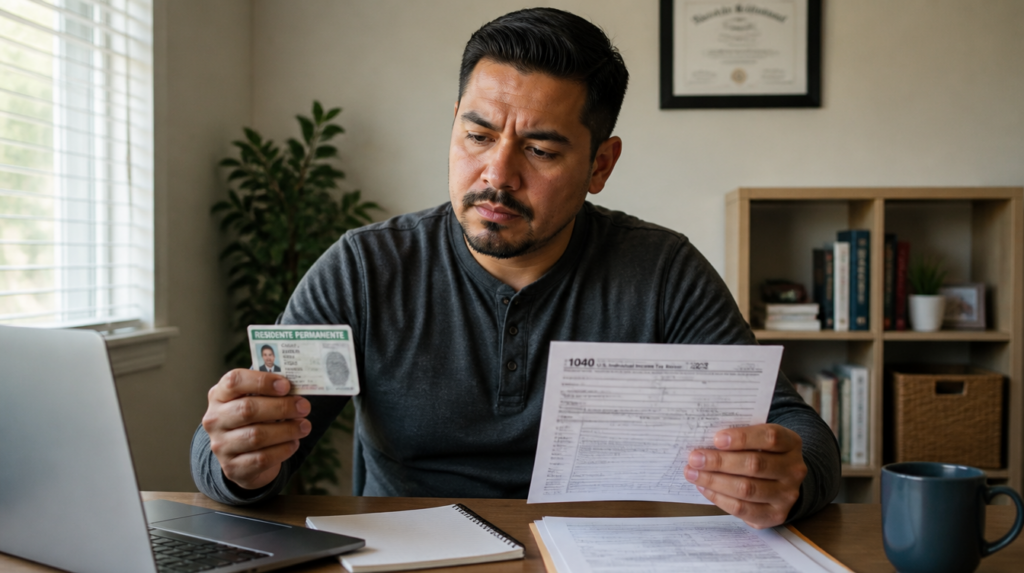
If you are an immigrant living in the United States, chances are you have heard both terms thrown around: ITIN and SSN. Many people assume they are the same thing, or that one can simply replace the other. They cannot. These are two entirely different identification numbers, issued by two different federal agencies, for two very different purposes. Confusing them — or not understanding their limits — can cost you time, money, and opportunities.
In this guide you will learn exactly what an SSN and an ITIN are, who can get each one, what you can and cannot do with them, how to use an ITIN to start building your financial life in the United States, and what happens when you eventually transition from an ITIN to an SSN. Whether you just arrived or have been living here for years without work authorization, this article gives you the full picture for 2026.
What Is an SSN (Social Security Number)?
A Social Security Number (SSN) is a nine-digit identification number issued by the Social Security Administration (SSA), a federal agency separate from the IRS. The format is AAA-BB-CCCC. It was originally created in 1936 to track workers’ earnings for Social Security retirement benefits, but over the decades it has become the primary identification number used across virtually every aspect of American life.
Who can apply for an SSN? Eligibility is limited to three groups:
- U.S. citizens — eligible from birth
- Lawful permanent residents (green card holders)
- Noncitizens authorized to work in the United States — including H-1B visa holders, F-1 students with work authorization (CPT/OPT), TN visa holders, DACA recipients, refugees, asylees, and others with valid Employment Authorization Documents (EAD)
If you do not fall into one of those three categories, you cannot get an SSN — period. Applying for one without eligibility is considered fraud.
What can you do with an SSN? Practically everything in the U.S. financial and legal system is built around the SSN:
- Work legally for any employer in the United States (required on Form I-9)
- Receive Social Security retirement, disability, and survivor benefits
- File federal and state income taxes
- Open a bank account at any financial institution
- Apply for credit cards, personal loans, auto loans, and mortgages
- Claim the Earned Income Tax Credit (EITC) and other refundable tax credits
- Apply for federal student loans and many government benefit programs
- Get a driver’s license in most states
- Apply for a U.S. passport
An SSN never expires once issued. It stays with you for life.
What Is an ITIN (Individual Taxpayer Identification Number)?
An Individual Taxpayer Identification Number (ITIN) is a nine-digit tax processing number issued by the Internal Revenue Service (IRS) — not the Social Security Administration. It always starts with the digit 9, formatted as 9XX-XX-XXXX. The fourth and fifth digits fall within specific ranges: 50–65, 70–88, 90–92, or 94–99.
The IRS created the ITIN in 1996 for one specific purpose: to allow people who are not eligible for an SSN to fulfill their U.S. tax obligations. The United States taxes income earned on its soil regardless of the earner’s immigration status. The ITIN is the mechanism that makes it possible for those individuals to file returns and pay what they owe.
Who can apply for an ITIN?
- Nonresident aliens who have U.S. tax filing obligations (for example, foreign nationals earning U.S. rental income or dividends)
- Undocumented immigrants living and working in the United States who cannot get an SSN
- U.S. resident aliens not eligible for an SSN
- Dependents or spouses of U.S. citizens or resident aliens who do not have SSN eligibility
- Dependents or spouses of nonresident alien visa holders
Critically, the IRS explicitly states that an ITIN does not authorize employment, does not provide eligibility for Social Security benefits, and does not change a person’s immigration status. The IRS also maintains a firewall: tax information submitted with an ITIN is confidential and cannot be shared with immigration enforcement agencies under normal circumstances, though 2026 has brought new legislative pressures on this policy that ITIN filers should monitor.
ITINs expire. If your ITIN was not used on a federal tax return for tax years 2022, 2023, or 2024, it expired on December 31, 2025, and you must renew it before filing. You can learn the full process in our guide on how to get an ITIN number fast.
ITIN vs SSN: Side-by-Side Comparison
The table below covers every major dimension where the two numbers differ. Study it carefully — many immigrants make costly mistakes by assuming ITIN and SSN are interchangeable.
| Feature | SSN | ITIN |
|---|---|---|
| Issued by | Social Security Administration (SSA) | Internal Revenue Service (IRS) |
| Who can apply | U.S. citizens, permanent residents, authorized workers | Non-resident aliens, undocumented immigrants, ineligible dependents |
| Primary purpose | Work authorization tracking, Social Security, broad ID | Federal tax filing only |
| Work authorization | Yes — required on Form I-9 | No — cannot be used as work authorization |
| Social Security benefits | Yes — retirement, disability, survivors | No |
| Federal tax filing | Yes | Yes |
| Earned Income Tax Credit (EITC) | Yes | No |
| Child Tax Credit (refundable portion) | Yes | Partial — non-refundable CTC only |
| Opening a bank account | Yes — accepted everywhere | Yes — accepted at many banks and credit unions |
| Credit cards | Yes — all issuers | Yes — Citi, Wells Fargo, and several others accept ITIN |
| Mortgage loans | Yes — all lenders | Yes — ITIN mortgage programs exist at select lenders |
| Auto loans | Yes | Yes — many lenders accept ITIN |
| Federal student loans (FAFSA) | Yes | No |
| Driver’s license | Yes — in all states | Depends on state — some states accept ITIN |
| Immigration status impact | Indicates lawful status | No impact — does not confirm or change status |
| Expiration | Never expires | Expires after 3 consecutive years of non-use |
| Format | AAA-BB-CCCC | 9XX-XX-XXXX (always starts with 9) |
| Issuing form | Form SS-5 | Form W-7 |
| Processing time | 2–4 weeks | 7–11 weeks (up to 14 weeks during peak season) |
Can an ITIN Replace an SSN?
No. An ITIN cannot replace an SSN, and the IRS itself is clear on this point. The two numbers exist for fundamentally different reasons and are issued by different federal agencies with different mandates.
Here is what an ITIN specifically cannot do that an SSN can:
- Authorize employment. If an employer asks you to complete Form I-9, you cannot use your ITIN. Work authorization requires an SSN or valid Employment Authorization Document.
- Earn Social Security credits. The years you work and pay taxes using an ITIN do not count toward your Social Security retirement or disability benefit calculation. Only work tied to an SSN builds those credits.
- Qualify you for the Earned Income Tax Credit. The EITC requires an SSN for every person on the return — you, your spouse, and each qualifying child.
- Access federal student aid. FAFSA requires an SSN.
- Serve as general government ID. While an SSN is used for many identification purposes, an ITIN is purely a tax number and is not accepted as proof of identity outside of tax contexts.
That said, an ITIN is far from useless outside of taxes. As we explain below, it opens doors to banking, credit, and even homeownership that many immigrants do not realize are available to them.
What Can You Do With an ITIN That Requires an SSN?
One of the most important things to understand about an ITIN is that the private financial sector — banks, credit card issuers, mortgage lenders — has more flexibility than the government. Many financial institutions have chosen to accept ITINs as an alternative to SSNs, recognizing that millions of immigrants are creditworthy customers who simply lack an SSN.
Opening a Bank Account With an ITIN
Many major banks and credit unions accept ITINs for account opening. This typically includes Bank of America, Wells Fargo, Citibank, Chase (at some branches), and many local credit unions. You will generally need your ITIN plus a government-issued photo ID (such as a passport or consular ID card) and proof of address. Some banks also accept a Matricula Consular or other consular identification documents alongside the ITIN.
Having a bank account is the foundation of your financial life in the U.S. It allows you to receive direct deposits, pay bills electronically, establish a relationship with a financial institution, and eventually qualify for other products.
Credit Cards With an ITIN
Several major credit card issuers accept ITINs in place of SSNs on applications. Citi and Wells Fargo are the most commonly cited examples among large banks. Additionally, newer fintech platforms designed specifically for immigrants often prioritize ITIN acceptance. Check our full guide on credit cards that accept ITIN for an updated list of issuers and their specific requirements.
Getting a credit card is one of the fastest ways to start building a U.S. credit history, which you will need for housing, car financing, and eventually a mortgage.
ITIN Mortgages
Yes, you can buy a home with an ITIN. ITIN mortgage programs — sometimes called non-QM or portfolio loans — are offered by a growing number of lenders who evaluate borrowers based on income documentation, bank statements, and credit history rather than immigration status. Down payment requirements are typically higher (10–20%) and interest rates are somewhat above conventional mortgage rates, but homeownership is genuinely accessible with an ITIN.
Auto Loans With an ITIN
Many auto lenders — including dealership financing arms and credit unions — accept ITIN borrowers. A solid payment history on an ITIN auto loan also helps build the credit profile you need for larger financial goals.
What You Cannot Do With an ITIN Instead of an SSN
Even within the private financial sector, some things remain SSN-only:
- Federal student loans and most private student loans
- Investment accounts at most major brokerages (though some fintech platforms now accept ITIN)
- Claiming certain tax credits (EITC, refundable portion of Child Tax Credit)
- Employment-based verification (I-9, E-Verify)
Can You Have Both an ITIN and an SSN?
No. You cannot legally hold both an active ITIN and an SSN at the same time. Once you obtain an SSN, your ITIN is automatically deactivated. The IRS policy is explicit: if you previously filed taxes with an ITIN and later obtain an SSN, you must notify the IRS so your tax records can be merged under your new SSN.
This is actually good news. The tax history you built under your ITIN — years of returns, payments, compliance — transfers to your SSN record. You do not lose credit for the taxes you paid.
If you acquire an SSN and continue using your ITIN on tax documents or financial accounts, it can trigger processing delays, mismatched records, and potential audit flags from the IRS. The moment you have an SSN, start using it everywhere and stop using your ITIN.
When Should You Get an ITIN Instead of Waiting for an SSN?
Some immigrants in the United States delay getting an ITIN because they hope to obtain an SSN soon. In most cases, this is a mistake. Here are the scenarios where you should apply for an ITIN now rather than waiting:
- You have U.S.-source income that requires a tax return. This includes self-employment income, freelance payments, rental income, or income from a U.S. business. Filing taxes is not optional — it is a legal obligation regardless of immigration status, and an ITIN is how you comply.
- You want to start building a U.S. credit history. The sooner you have an ITIN and open financial accounts, the sooner your credit history starts. Credit history is time-dependent, so every month you delay is a month of potential history lost.
- You are listed as a dependent on a U.S. citizen’s or resident’s tax return. If your spouse or parent is filing taxes and wants to claim you, you need an ITIN.
- You receive U.S. rental income, investment income, or other passive income. Even nonresident aliens owe U.S. tax on certain income earned here.
- You want to demonstrate your record of tax compliance for future immigration applications. A long history of filing taxes with an ITIN can be a positive factor in immigration proceedings and demonstrates good moral character. You can learn how to file taxes with an ITIN in our step-by-step guide.
The bottom line: if you do not have an SSN and you have any U.S. financial presence at all, an ITIN almost always makes sense to obtain as soon as possible.
How to Upgrade From ITIN to SSN
The transition from ITIN to SSN happens when you become eligible for an SSN — typically through obtaining a green card, an Employment Authorization Document (EAD), or another form of work authorization. Here is the full process:
Step 1: Obtain Work Authorization
You must be legally eligible for an SSN before you can apply. Common paths include receiving a green card (lawful permanent residence), being approved for an H-1B, L-1, O-1, or other work visa, receiving an EAD through an I-485 pending application, DACA renewal, TPS, or other programs, or receiving refugee or asylee status.
Step 2: Apply at the Social Security Administration
Visit your local SSA office with Form SS-5, your immigration documents showing work authorization, and a valid government-issued ID. SSN cards are typically mailed within 2–4 weeks. You can also apply by mail in some circumstances. The SSA website lists required documents based on your visa or status category.
Step 3: Notify the IRS
Once you receive your SSN, write to the IRS ITIN Operations unit in Austin, Texas. Your letter should include your full name, mailing address, ITIN, new SSN, and a copy of your new Social Security card. Request that the IRS rescind your ITIN and merge your tax records under your new SSN. This process takes approximately 6–8 weeks.
Step 4: Update All Financial Accounts
Contact every bank, credit card issuer, lender, and financial institution where you used your ITIN and update your records to reflect your new SSN. This ensures your credit history is properly attributed and your accounts are linked correctly.
What Happens to Your Tax History?
Good news: all prior tax filings, payments, refunds, and credits recorded under your ITIN are merged into your new SSN record by the IRS. You do not lose any of your compliance history. Your credit history with financial institutions should also carry over once you update your information with each institution.
ITIN and Credit Building
One of the most powerful things you can do with an ITIN — and one of the least understood by recent immigrants — is build a U.S. credit history. Your credit score in the United States follows you for decades and determines whether you pay premium or standard rates on mortgages, car loans, insurance, and more.
Here is how to build credit systematically with an ITIN:
Step 1: Open a Bank Account
This does not directly build credit, but it establishes your banking relationship and is required for the steps that follow.
Step 2: Get a Secured Credit Card or ITIN Credit Card
Secured credit cards require a deposit that becomes your credit limit. Several issuers offer them to ITIN holders. Use it monthly for small purchases and pay the full balance every month. After 6–12 months of on-time payments, your credit score will begin to materialize. See our list of credit cards that accept ITIN for specific recommendations.
Step 3: Add a Credit Builder Loan
Credit builder loans are specifically designed to help people with thin or no credit history. You make fixed monthly payments, and those payments are reported to the credit bureaus. At the end of the term, you receive the accumulated funds. Many credit unions and fintech lenders offer these to ITIN holders. Explore credit builder loans for immigrants to find programs available in your state.
Step 4: Become an Authorized User
If you have a family member or trusted friend with a long-standing U.S. credit card account in good standing, ask them to add you as an authorized user. Their positive payment history on that account can appear on your credit report and boost your score significantly.
Step 5: Pay Everything on Time
Payment history accounts for 35% of your FICO score. This is the single most important factor. Set up autopay for at least the minimum payment on every account, and aim to pay balances in full each month to avoid interest charges.
With disciplined credit-building using an ITIN, it is realistic to reach a good credit score (670+) within 18–24 months. When you eventually transition to an SSN, that credit history goes with you.
2026 Tax Changes Affecting ITIN Holders
The legislative environment in 2026 has introduced new restrictions that ITIN filers need to be aware of when filing their 2025 tax returns:
- New deductions require an SSN. The Overtime Pay Deduction, Tips Deduction, and Student Debt Exclusion introduced for 2025 returns are available only to filers with valid SSNs. ITIN filers cannot claim these.
- ITIN expiration. ITINs not used on a federal return for tax years 2022, 2023, or 2024 expired December 31, 2025. If your ITIN expired, you must renew it by submitting Form W-7 before or with your 2025 return.
- Data sharing concerns. Legislation and executive actions in 2025–2026 have created new frameworks around potential data sharing between the IRS and immigration enforcement. While the traditional confidentiality protections for tax information remain codified in law, ITIN filers should consult a qualified tax professional or immigration attorney if they have concerns about their specific situation.
Despite these challenges, filing taxes with an ITIN remains the legally required and financially wise choice for anyone with U.S. income who is not eligible for an SSN.
Frequently Asked Questions
Is an ITIN the same as a Social Security Number?
No. An ITIN and an SSN are completely different numbers issued by different federal agencies for different purposes. An SSN is issued by the Social Security Administration for work authorization, Social Security benefits, and general identification. An ITIN is issued by the IRS solely for federal tax processing. They have different formats (SSNs start with any digit; ITINs always start with 9) and different eligibility rules.
Can I work in the US with an ITIN?
No. An ITIN does not grant work authorization and cannot be used on Form I-9 or in E-Verify. If an employer asks you to verify work authorization, only an SSN combined with lawful work authorization documents will satisfy that requirement. Working without proper authorization is a separate legal issue from having an ITIN for tax purposes.
Does having an ITIN affect my immigration status?
No. The IRS explicitly states that an ITIN does not change your immigration status, does not provide legal immigration status, and cannot be used to prove lawful presence in the United States. Applying for and using an ITIN is a tax obligation matter, not an immigration status matter. However, a long record of tax compliance can be a positive factor in future immigration applications.
Can I open a bank account with an ITIN instead of an SSN?
Yes, at many financial institutions. Bank of America, Wells Fargo, Citibank, and many credit unions accept ITINs for account opening, typically alongside a government-issued photo ID and proof of address. Requirements vary by institution, so call ahead or visit a branch to confirm what documentation they accept. Some community banks and credit unions specifically serve immigrant communities and are especially ITIN-friendly.
Will my ITIN history transfer to my SSN when I get one?
Yes, for tax records. Once you obtain an SSN and notify the IRS in writing, the agency merges your prior ITIN tax history — returns, payments, refunds, credits — under your new SSN. For credit history, you will need to update your information with each financial institution individually, but your credit history with those institutions should carry over once the update is processed.
Can I get a driver’s license with an ITIN?
It depends on the state. Several states — including California, New York, Illinois, and about 19 others — issue driver’s licenses to undocumented immigrants regardless of SSN status. These states typically accept an ITIN or other documentation during the application process. Other states require a valid SSN. Check with your state’s Department of Motor Vehicles for the specific requirements in your location.
Can ITIN holders receive Social Security benefits?
No. Social Security retirement, disability, and survivor benefits are calculated based on work credits earned through employment tied to an SSN. Years of work reported under an ITIN do not count toward Social Security benefit calculations. If you later obtain an SSN and work authorization, only the years of SSN-linked employment will count toward your Social Security benefit. This is one of the most significant long-term financial disadvantages of working without authorization and without an SSN.
The EducaDinero editorial team specializes in personal finance for Latino immigrants in the United States. Our guides are reviewed for accuracy and updated annually to reflect the latest IRS rules and financial regulations.